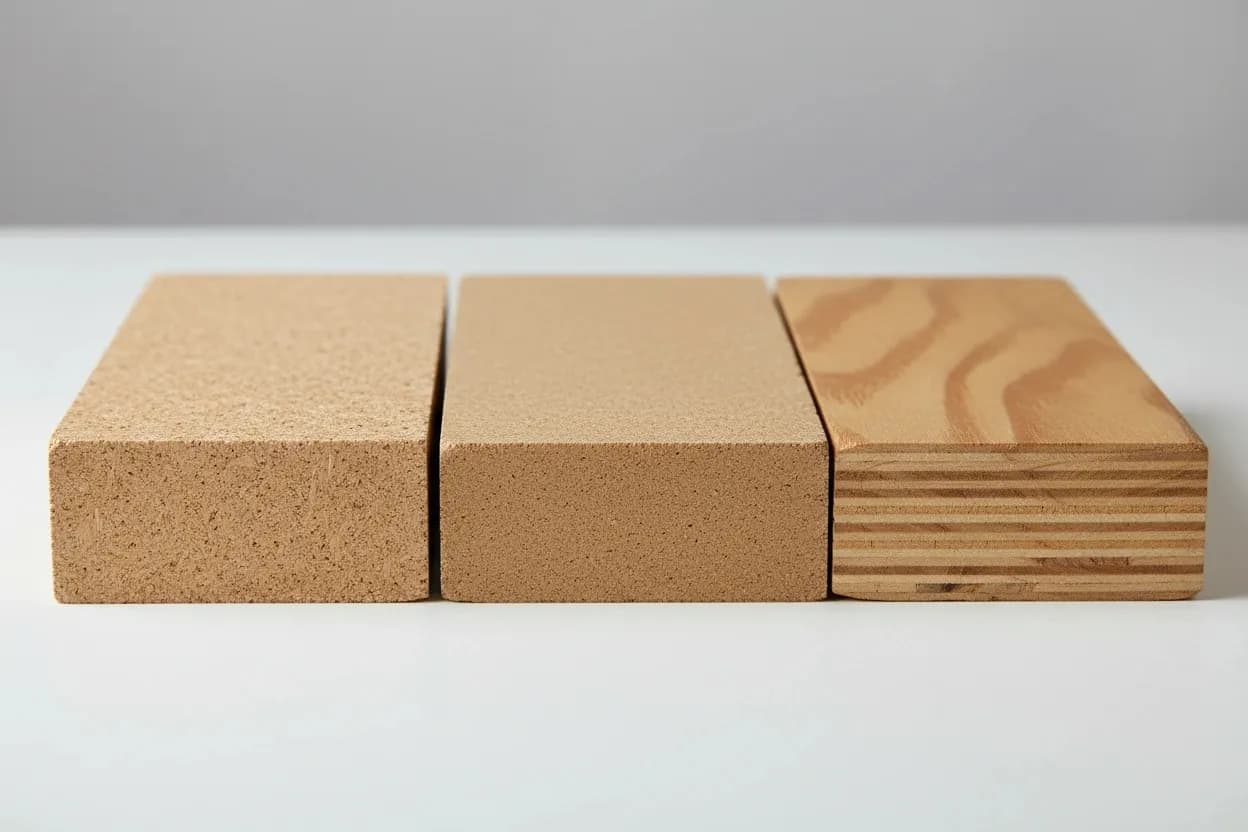
If you are planning custom carpentry in Singapore, you will be asked one question early on: plywood or particle board? The answer affects how long your wardrobes and kitchen cabinets last — and how much they cost.
This guide explains the real differences, how each performs in Singapore's humidity, and where each material makes sense.
What Is Plywood?
Plywood is made from thin layers of wood veneer glued together in alternating directions. That cross-grain construction gives plywood exceptional strength and dimensional stability.
Commonly used in Singapore for: kitchen cabinets, bathroom vanities, built-in wardrobes, structural carpentry and any area exposed to moisture.
What Is Particle Board?
Particle board (also called chipboard) is made from wood chips and sawdust bound with resin and pressed into boards. It is flat, uniform and inexpensive.
Commonly used in Singapore for: budget wardrobes, TV consoles, display shelving, flat-pack furniture and dry-area cabinetry.
Direct Comparison
Factor | Plywood | Particle Board |
|---|---|---|
Strength | High — cross-layered veneers | Moderate — chips bond weakly at edges |
Screw Holding | Excellent, holds repeatedly | Weak, crumbles if re-screwed |
Moisture Resistance | Good to excellent | Poor — swells and disintegrates |
Weight | Heavier and denser | Lighter |
Cost | Higher | Lower |
Lifespan (Singapore) | 10 – 20+ years | 3 – 8 years typical |
Edge Finishing | Can be edge-banded cleanly | Edges chip easily |
Repairability | Can be sanded and repaired | Difficult — usually replaced |
Best Used For | Kitchens, bathrooms, wardrobes | Dry areas, tight budgets |
How Each Performs in Singapore's Humidity
Singapore averages 80%+ relative humidity year-round. That single fact changes the entire calculation.
Particle board absorbs moisture through cut edges and unsealed surfaces. Once it swells, it never returns to its original shape. You will notice the classic symptoms: cabinet doors that no longer close, bottoms that sag, and a crumbly texture at the corners.
Plywood handles humidity far better because of its cross-grain construction. Even if moisture penetrates, the layers hold together. Moisture-resistant grades use waterproof adhesives and perform even better.
In Singapore, particle board used in kitchens and bathrooms is one of the leading causes of premature carpentry failure. It is a false economy.
Cost Differences in Singapore
Item | Particle Board | Plywood |
|---|---|---|
Built-in wardrobe (per foot run) | $180 – $280 | $280 – $450 |
Kitchen cabinet (per foot run) | $150 – $250 | $250 – $420 |
TV console (typical) | $600 – $1,200 | $1,000 – $2,200 |
Full 4-room flat carpentry | $6,000 – $12,000 | $10,000 – $22,000 |
The plywood premium is typically 30% to 60%. Over a 15-year period, that premium is almost always recovered through avoided replacement.
Where Plywood Is Worth Every Dollar
Kitchen base cabinets — constant moisture, heat and heavy loads
Bathroom vanities — direct water contact and high humidity
Built-in wardrobes — high daily use and load-bearing shelves
Under-sink cabinets — the single most moisture-prone spot in any home
Any carpentry near windows — rain exposure and condensation
Where Particle Board Is Acceptable
Bedroom TV consoles in dry, air-conditioned rooms
Display shelving that carries light loads
Short-term rental or investment property fit-outs
Temporary carpentry before a future renovation
Areas where budget is the hard constraint and lifespan is not critical
Finishes Matter As Much As the Core
The visible finish is usually laminate, veneer or solid surface — and it dramatically affects performance.
Laminate: Durable, easy to clean, huge range of designs, resistant to scratches.
Veneer: Real wood look and feel, needs more care, can be sanded and refinished.
Solid surface: Seamless, non-porous, repairable — excellent for counters and vanities.
Edge banding: The weak point of any cabinet. Poorly glued edge banding lets moisture straight into the core.
Warning Signs of Poor Carpentry
Doors that start sticking within six months
Drawers that feel loose or wobble on their runners
Visible swelling at the bottom of cabinets
Edge banding peeling away
Screws that will not tighten because the hole has crumbled
A chemical smell that lingers for weeks after installation
Questions to Ask Your Carpentry Contractor
What core material will you use for the carcase, doors and shelves?
Is the plywood moisture-resistant or standard grade?
What thickness are the panels — 15mm, 18mm or thinner?
Are the cabinet backs solid boards or thin hardboard?
What type of hinges and drawer runners are being used?
Are the edges fully sealed against moisture?
What warranty covers the carpentry?
Any contractor who cannot answer these clearly is not the right choice.
Frequently Asked Questions
Is plywood really necessary for kitchen cabinets in Singapore?
Strongly recommended. Kitchens combine heat, steam and frequent water exposure — precisely the conditions particle board handles worst.
Can particle board be used if the edges are sealed properly?
Sealing helps and extends lifespan, but does not eliminate the risk. Any scratch or moisture ingress through a screw hole or edge can still cause swelling.
What thickness should cabinets be?
18mm is ideal for carcases and shelves carrying weight. 15mm is acceptable for lighter applications. Anything thinner will flex over time.
Which is better for a bathroom vanity?
Plywood, without question. Bathroom vanities take the most moisture abuse of any carpentry in a home.
Does plywood need special treatment in Singapore?
Use moisture-resistant grade plywood with sealed edges, and keep the area well ventilated. That combination performs very well long term.
How long does custom carpentry last in Singapore?
Properly built plywood carpentry with quality hardware typically lasts 10 to 20+ years. Particle board in damp conditions often lasts under 5 years.
Get Custom Carpentry Built to Last in Singapore
Asia Engineering & Construction Pte Ltd designs and builds custom wardrobes, kitchen cabinets, TV consoles and built-in storage across Singapore.
📞 Mobile / WhatsApp: +65 9812 5706
✉️ Email: asiahandyman@gmail.com
📍 Address: 7A Jalan Papan, Singapore 619408
🕐 Opening Hours: 24 Hours / 7 Days